Capability Aware · Research
Beyond Fixed Visual History:Learning Motion-Adaptive Temporal Receptive Fields for Complex-Terrain Quadruped Locomotion
1 · Westlake University, Hangzhou, China
2 · East China University of Science and Technology, Shanghai, China
Preprint coming soon
Abstract
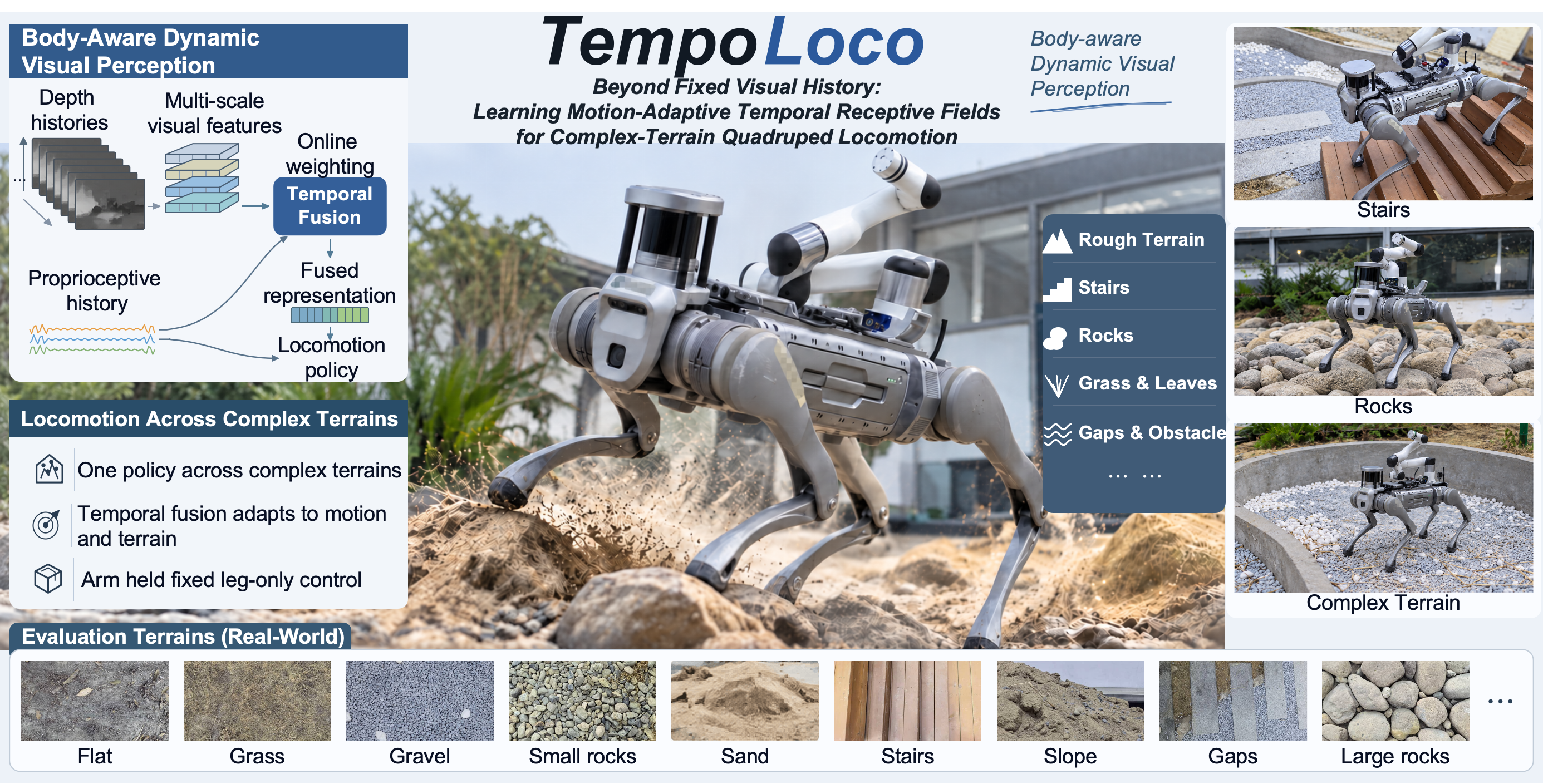
Versatile quadruped locomotion depends on a tight coupling between what the robot perceives and what its body can execute. Yet existing visual controllers typically organize depth history using fixed temporal patterns, overlooking that the same temporal span corresponds to different spatial ranges as the robot’s speed, posture, and gait phase change. Consequently, the same visual history may be insufficient in one motion state but outdated or misaligned in another. To address this limitation, we propose TempoLoco, a body-aware dynamic visual perception framework that organizes visual memory according to the robot’s current locomotion state. TempoLoco learns multiple complementary temporal views from a long depth buffer, encodes them within a shared feature space, and dynamically aggregates them using proprioceptive history and multi-scale terrain evidence. This enables a single policy to align visual anticipation with the robot’s current motion capabilities across complex terrains, including stairs, platforms, gaps, discrete obstacles, rough ground, and slopes. From the experiment analysis, TempoLoco achieves a 78.4% success rate, compared with 58.2% for the strongest fixed-history baseline and 62.1% for uniform multi-scale fusion. In separate capability evaluations, it completes 41/45 simulated trials across nine terrain types and 23/25 real-world trials on a Unitree B2 with a fixed arm, demonstrating robust and deployable locomotion through body-aware dynamic visual perception.
Method Overview
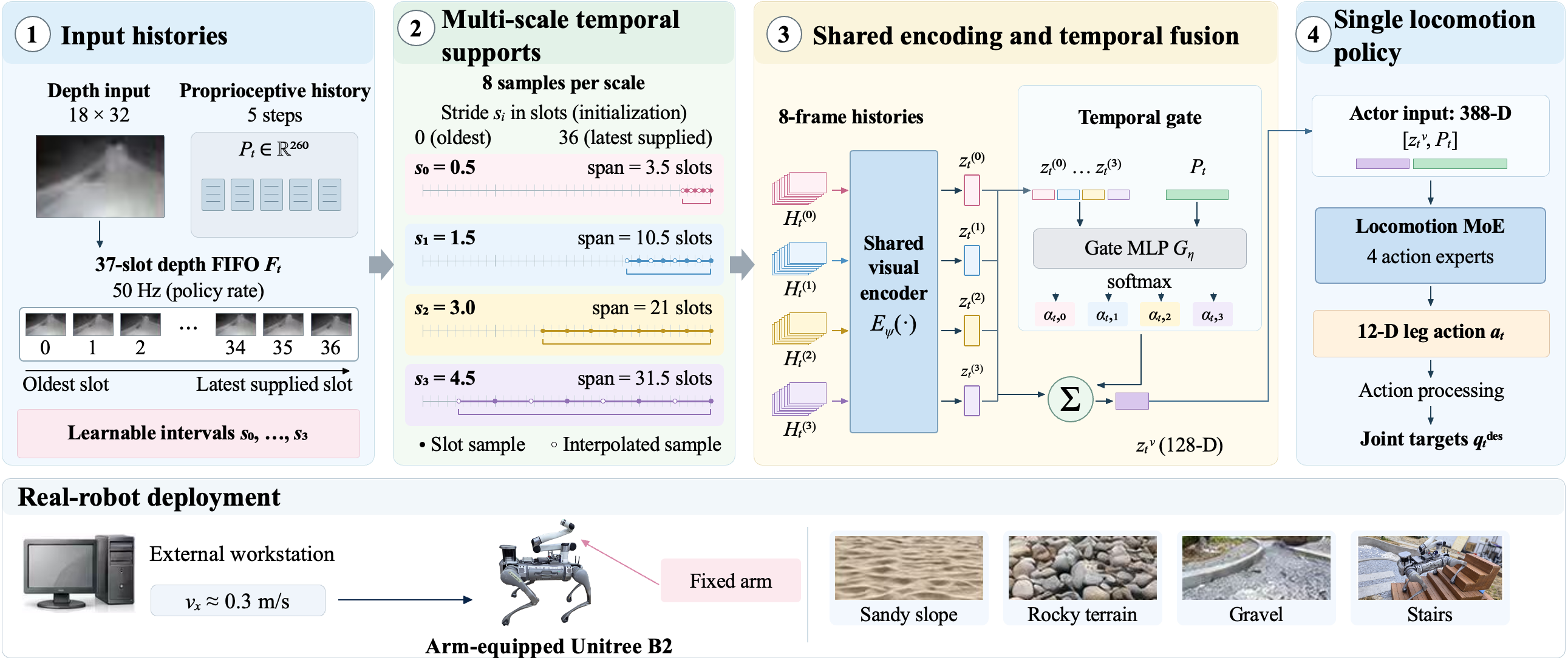
TempoLoco separates global temporal-scale learning from state-conditioned fusion. Four globally learned continuous strides sample complementary eight-frame histories from a 37-slot depth buffer. A shared visual encoder maps these histories into a common feature space; a temporal gate combines them using five-step proprioceptive history and multi-scale terrain evidence. The learned strides remain fixed after training, while fusion weights adapt at every policy step. A single locomotion policy produces targets for the twelve leg joints.